
“That’s no moon”
Star Wars, Voyager 1, a Saturnian moon and Arthurian legends

Every Star Wars fan knows the origin of that iconic statement: “That’s no moon.”
For those who have never seen the original film in the franchise, “Episode IV: A New Hope” was released in 1977.
Jedi master Obi-Wan Kenobi utters the immortal line as the heroes hurtle through space aboard their spaceship, the Millennium Falcon, toward the Death Star.
And the Death Star is no star either. It just happens to be a titanic space station weapon capable of destroying entire planets and is owned and operated by one evil Galactic Empire.
But to be fair to our intrepid heroes of the Rebel Alliance, the Death Star does look like a moon. But it’s not in a galaxy far, far away.
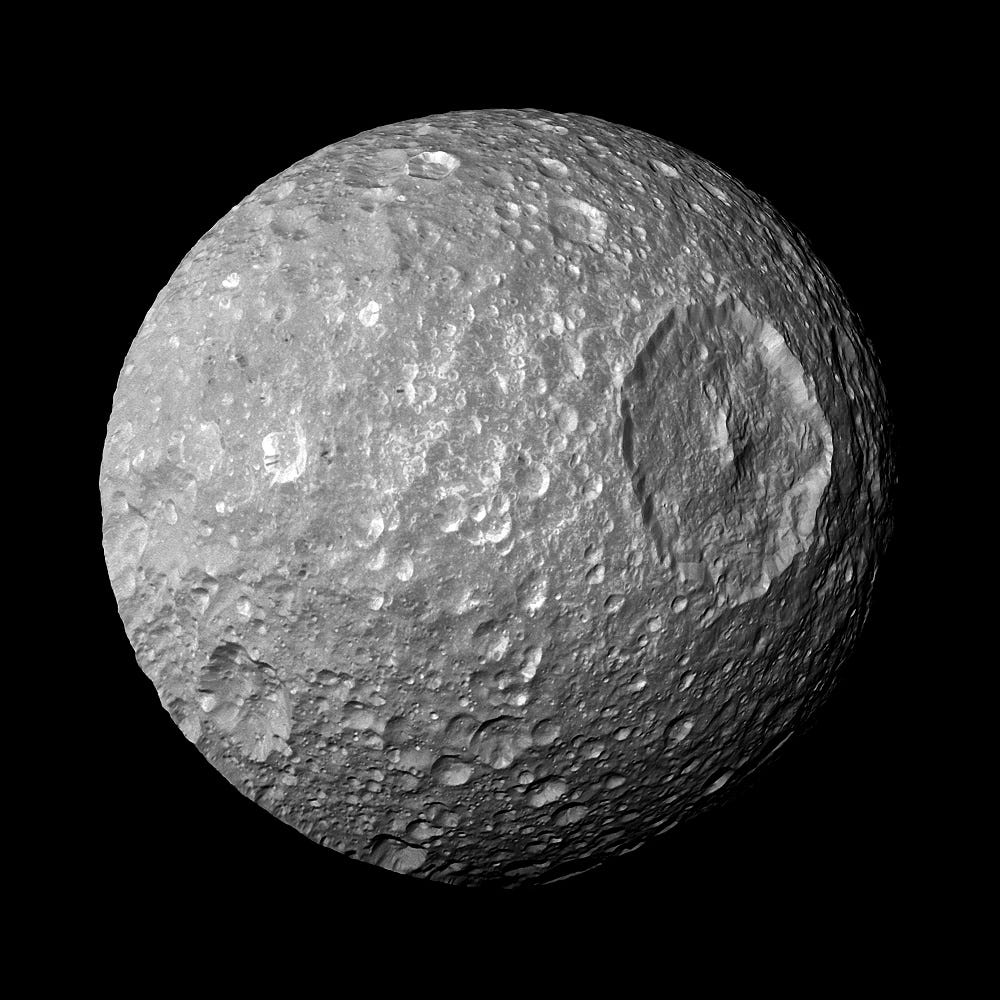
In fact, one of the natural satellites of the beautiful planet Saturn in our own solar system could be the Death Star’s twin. Yes, I’m talking about Mimas, one of the Saturnian moons discovered by the astronomer William Herschel back in 1789.
With the 40-foot telescope of his day, Herschel likely could not distinguish the giant crater that makes Mimas so distinctive. It’s actually the second-largest crater of any moon in our solar system, measuring more than 80 miles in diameter.
And it’s that giant crater in the center of Mimas that makes the moon look so much like the Death Star with its central superlaser array.

Mimas is named after one of the Giants in Greek mythology, and it was Herschel’s son, John, also a famous astronomer, who suggested the moon’s name.
Craters on moons also get names. Guess what name the giant crater on Mimas is called?
If you said Obi-Wan, sorry! It was named Herschel after the moon’s discoverer.
Since I muse on intersections of art and science, you might think this post is all about the connection between Mimas and “Star Wars.” But there’s a connection to literature I wish to explore.
The crater Herschel may be the largest feature on Mimas, but it is not alone. There are many other smaller craters and chasms, also known as chasmata, that mar the surface of Saturn’s innermost moon.
Some of the chasmata have been named after the legends of the Titans, also from Greek mythology. But most of Mimas’ chasmata and craters refer to very different legendary characters and places.
No, still not Star Wars.
Instead, we have to travel back in time to the gallantry and heroism of the Arthurian legends of Britain. That’s right, we’re talking about King Arthur. Yes, the fellow who pulls the sword from the stone and is declared king.
And no it wasn’t a light saber.
You might think it was Excalibur, Arthur’s famous magical sword. But the Arthurian legends come from a range of medieval sources, and in some of those tales Arthur receives Excalibur directly from the Lady of the Lake.
All the various medieval stories and Welsh myths get a bit jumbled, but in 1485 probably the most well-known of the accounts of King Arthur is published. English author Sir Thomas Malory gathered many of the wild stories, fusing them into one massive prose chronicle called Le Morte D’Arthur (The Death of Arthur).
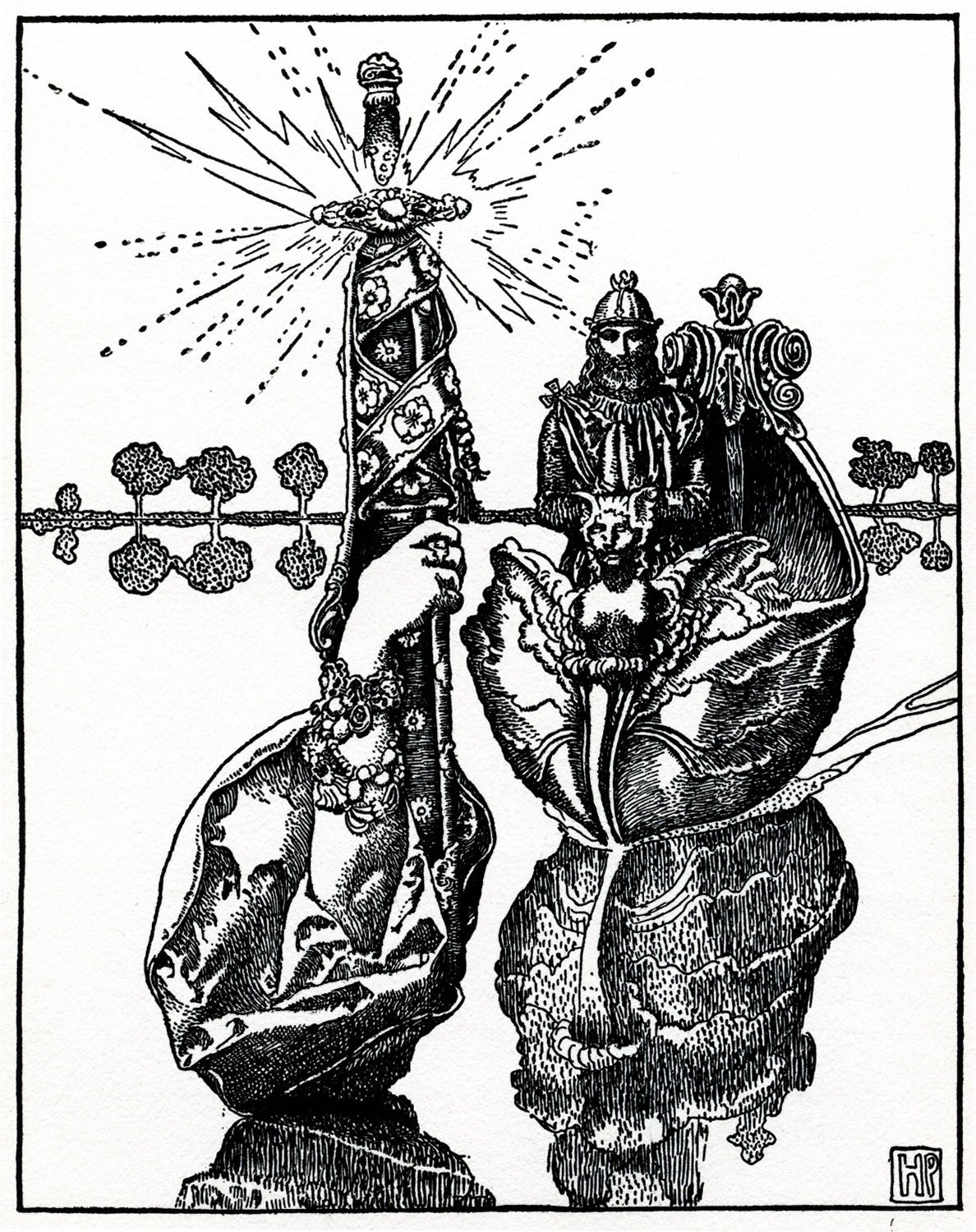
Since then, Mallory’s text has been the springboard of countless retellings, reworkings and reimaginings of the legendary Arthur, King of the Britons. Think Tennyson’s Idylls of the King, T.H. White’s The Once and Future King, or even the classic Monty Python and the Holy Grail.
Herschel may be the largest Mimantean feature, but the International Astronomical Union has turned to Arthurian legends for most of the others.
The King Arthur stories feature many colorful characters and places. Besides the king, there’s Guinevere and Lancelot, Merlin and Morgan le Fay, Percival and Galahad, Camelot and Avalon.
You’ll find those names and others from Arthurian lore (with different spellings) among the craters and chasmata that scar Saturn’s closest satellite, Mimas. You can see a full list of names and descriptions on the Department of the Interior’s U.S. Geological Survey’s Gazetteer of Planetary Nomenclature at Planetary Names (usgs.gov).
One name not on the list: Excalibur. That’s because craters refer to characters and chasmata are named after places. So far, no weapons included.
Which takes us back to the Death Star and its resemblance to Mimas. The original Star Wars film was released on May 25, 1977. Three years later NASA’s Voyager I spacecraft would hurtle through the Saturnian system sending back the first close-up images of Mimas.
That was in November of 1980.
Mimas is often called the Death Star moon. Its resemblance to the awesome weapon in Star Wars is remarkable. Especially when you consider that detailed images of Mimas with its giant crater that almost broke it into pieces weren’t available when George Lucas and crew created the legendary film.
Now imagine if Lucas had called his Mimas-doppleganging, world-shattering superweapon something other than the Death Star. Oh, I don’t know, how about …
Excalibur!