
Honoring a GOAT
Natural philosophy, Isaac Newton, Westminster Abbey and one monumental grave

Sir Isaac Newton had a pretty good run of life – about 84 years – and had made a name for himself with some scientific and mathematical successes. Things like, oh, formulating the laws of motion and universal gravitation and developing calculus, not to mention some transformative work with optics.
As a natural philosopher back in the 1700s, he published a book called Philosophiæ Naturalis Principia Mathematica (Mathematical Principles of Natural Philosophy for us non-Latin speakers), which is basically the foundation of classical mechanics in physics.
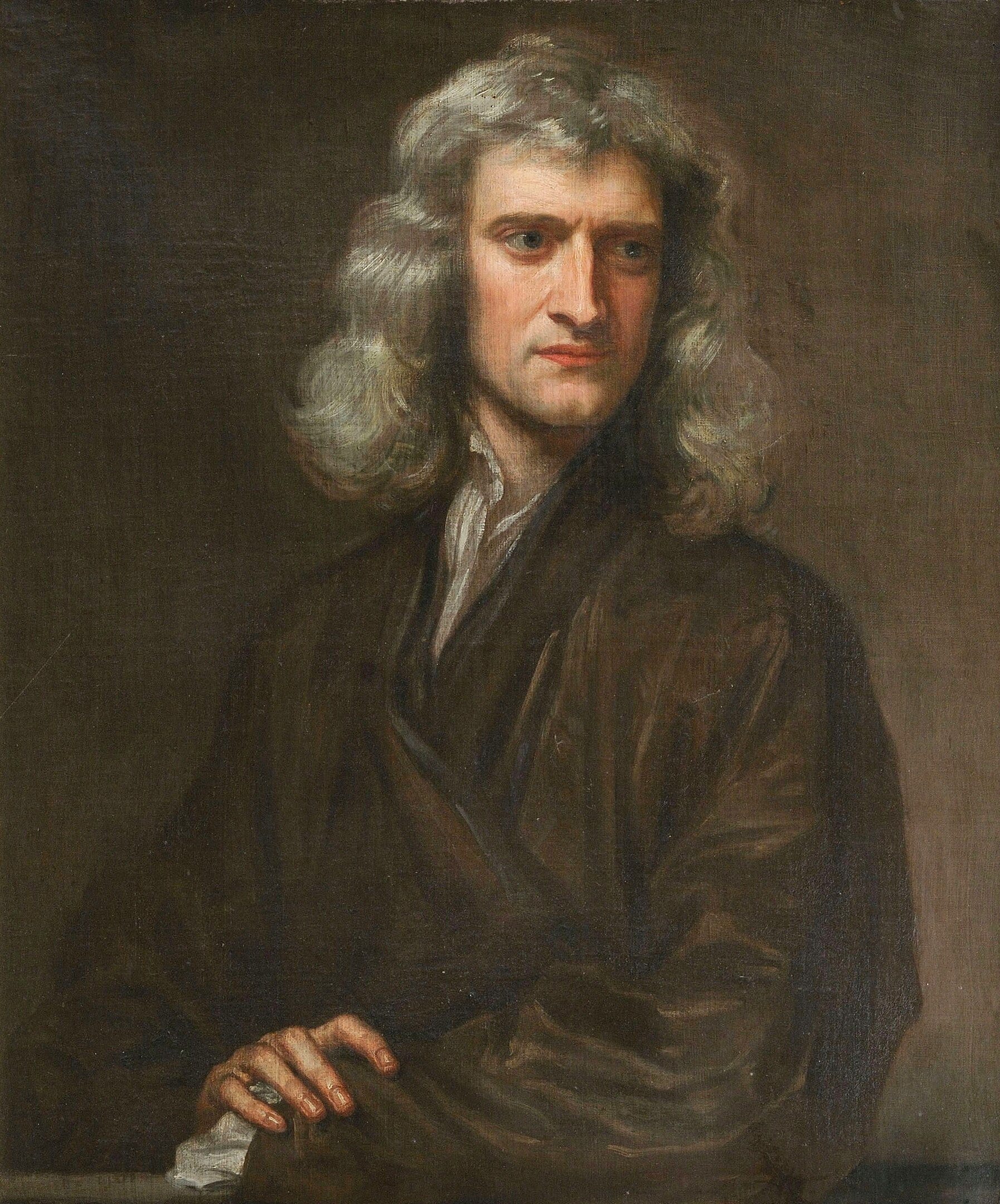
Sir Newton was unquestionably a big deal in science then and still is today. If there was a Mount Rushmore for scientists, he’d be on it. For sure.
Newton died on either March 20 or March 31, 1727, depending on whether you are using the Julian (Old Style) calendar or the later Gregorian (New Style) one, which was established by Pope Gregory XIII in 1582.
But you see the United Kingdom didn’t want anything to do with that popish calendar system and hung onto the old one created by Julius Caesar until 1752. Then they had to pretty much wipe out 11 days during that year because the calendar was so out of kilter with real life.
Hence the asterisk for Newton’s death day. And birthday, too, since that changes from Dec. 25, 1642, to Jan. 4, 1643. No more Christmas Day baby.
So when Newton shuffled off his mortal coil on either March 20 (if you were British) or March 31 (if you were most of the rest of the world), it was a big deal. A really big deal. Lying in state kind of deal.
He was buried about a week later with the Lord Chancellor as one of his pall bearers with many fellows of the Royal Society following along. He was laid to rest in the Collegiate Church of St. Peter; but most people call it Westminster Abbey – the place where they crown English monarchs.

You can still see Newton’s grave there, especially as it’s graced with a monument that was designed by the architect William Kent and executed by the sculptor Michael Rysbrack. Unveiled in 1731, Newton’s memorial is made of marble, featuring a reclining figure of Newton himself wearing classical garb.
A relief panel shows boys using a variety of scientific instruments associated with Newton or with his work as Master of the Mint. The figures use a telescope, look through a prism, balance the Sun and planets, and carry pots of coins.
The great natural philosopher’s effigy rests against books that are labeled “Divinity,” “Chronology” “Opticks” and “Philo. Prin. Math” while he points to a scroll featuring a “converging series” of mathematical design.
At the back of the monument is a pyramid topped by a celestial globe with the signs of the Zodiac and the path of the comet of 1680. Atop the globe sits Urania, muse of Astronomy, leaning on a book.
At the base of the monument is a Latin inscription that lauds his scientific achievements – and religious faith – very nicely and includes a rather bold call: “Mortals rejoice that there has existed such and so great an ornament of the human race!”
Newton once wrote to fellow natural philosopher Robert Hooke: “If I have seen further, it has been by standing on the shoulders of giants.” He rests eternally now in the abbey’s Scientists’ Corner, which also houses the graves of Michael Faraday, James Clerk Maxwell, Charles Darwin and more recently, Stephen Hawking. To view them, visit www.westminster-abbey.org.
Despite what a few cryptic clues in Dan Brown’s hit bestseller The Da Vinci Code might propose, Alexander Pope didn’t actually eulogize Newton at the service, and his epitaph for the great scientist isn’t part of the ornate monument.
The English poet of the Enlightenment period did, however, write a famed couplet about Newton:
Nature and Nature’s Laws lay hid in Night:
God said, ‘Let Newton be!’ and all was light.
Maybe that would make a fitting addition to Newton’s monument.
A GOAT deserves plenty of praise after all!